 Free
Free
AI Future Baby Generator Maker
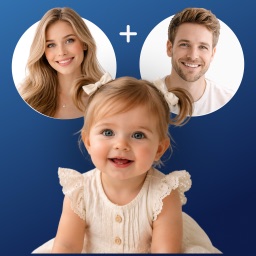
Meet your future baby, powered by AI.
Blog · 15 October 2026
Almost every parent-to-be wonders whose eyes, nose or smile the baby will get. Genetics gives a few firm answers, some rough odds and plenty of room for surprise. Here is what is known, and where the free calculators on this site can help.
A baby gets half of its DNA from each parent, but which half is reshuffled for every child. That is why brothers and sisters can look so different, and why a baby can show a feature that neither parent has but a grandparent did. Most visible traits, from face shape to eye color, depend on many genes at once, so there is no single gene for a nose or a chin to look up.
You may have heard that babies resemble their fathers, supposedly so that dads can be sure the baby is theirs. The idea goes back to a small 1995 study in Nature, in which strangers matched photos of one-year-olds to their fathers more often than to their mothers.
Later studies did not find the same thing. In 1999, people matched children to their mothers and fathers equally well, and a larger study in 2004 concluded that some babies look more like their father, some more like their mother, and most resemble both about equally. A study of newborns even found that strangers matched babies to their mothers more easily, while the mothers themselves tended to say the baby looked like the father.
The baby you meet on day one isn't the final version. Eye color can keep changing through the first year or longer as pigment builds up in the iris, and face shape keeps changing right through childhood. A resemblance that seems obvious at three months can fade by three years, and the other way round.
Apps that show your future baby blend features from both parents' photos into a plausible child's face. That can be great fun to share, but it isn't a genetic prediction: no app can know which versions of each gene your baby will inherit.
Our AI baby generator is made for exactly that kind of fun: upload a photo of each parent and get a playful preview of a possible baby.
This guide simplifies the genetics. If a test result surprises you, such as an unexpected blood type, a doctor can explain what it does and doesn't mean.
Free
Meet your future baby, powered by AI.